“A sense of relief among many friends that a long nightmare had come to an end—and above all optimism. At least in those first three or four years. I myself wasn’t there immediately after the revolution; I started in October 1990, almost a year after it. The people I knew—who usually belonged to the second academic tier because they didn’t have a party membership card—suddenly became the first tier. The people who, during normalization, had taken the places of those who for whatever reason were ‘wrong’—like Professor Macháček, who later became a stoker or a warehouse worker in a library—that generation was in power. They were people with the right political profile, often also politically ambitious. They accepted those functions because they got a good position in return. They were around thirty to thirty-five years old at the beginning of the 1970s. And almost thirty years later, those same people were practically retired. So all those senior functionaries either took early retirement or regular retirement, because the retirement age was sixty then—for women even reduced according to the number of children. And those who had been pushed out back then and had stayed active in the underground universities became the new leaders. Or people who had remained and did the actual work—like Vašek Bok in České Budějovice, Jana Nechutová in Brno, Karel Müller at the archive of the Silesian Museum—those suddenly became heads. As a young man I suddenly knew people in academic management, and that made my professional progress possible. Maybe an undeserved stroke of luck, but on the other hand I still had contacts from the time before. You could feel that people were throwing themselves into building a normal society. The years 1994 and 1995 were, in any case, wonderful years that I remember with great pleasure, and I’m incredibly glad I got to experience that here. It was just an enormous amount of positive energy.”
“We came from Brno. Nowadays the train takes an hour and a half, but back then it was a single track. We were met by the father of a friend, the musician Pavel Čtvrtlík, who had fled after 1968 and played in the Utrecht Philharmonic. When he heard we were going, he gave us gifts for his father, whom he couldn’t see because he had left the country ‘illegally’. We stayed in Hodolany. We had a photo with us so we could recognize each other. The next day we went into the city. We walked along Lenin Avenue—today Masarykova. Wide pavement. Suddenly Mr. Čtvrtlík pulled us abruptly to the other side. It was immediately clear why. A group of Soviet soldiers was coming, across the entire width of the sidewalk, three rows thick, drunk, with beer. They behaved like the masters of the city. Only later did I learn that there was a garrison of about twenty thousand soldiers here. All of Neředín consisted of Soviet barracks—a town within the town. They had the airfield, with their helicopters. It was a mess. They behaved like occupiers. And another thing was that you felt something we never felt like that before or after: fear in the city. Like a layer of cotton hanging over it. It’s hard to describe. There was something in the atmosphere that didn’t belong there. In Olomouc everything was grey, neglected. Compared with Brno it was a shock. My grandmother had always told me how beautiful Olomouc was, but she had left in 1928. In Prague it was a completely different experience again. From that perspective, Olomouc was a disappointment. Only after 1989 did the city become more and more beautiful, with a lot of renovation.”
“In 1985 I had to apply for a visa and I had to buy Czechoslovak crowns as an обязатель thing. There was a note added and so on. The visa was a little slip of paper where you had to fill in where your parents were born and what nationality your grandparents had. At home we thought about that quite a lot. And truthfully we filled in that my father was born in Santiago de Chile and my mother in Jakarta—Batavia. But that wouldn’t have meant anything to the Czechoslovak officials. And because we couldn’t fill in where the grandparents were born, I wrote ‘Dutch’ everywhere. They all had Dutch nationality, so that was simply the truth. If I had filled in that they were born in the Czech lands of the monarchy or in Czechoslovakia, I would never have gotten that visa. At home, friends who studied Eastern Europe said: Czechoslovakia—count on being checked everywhere and having to report everywhere. We planned a ten-day round trip with at least five moves, and each time we were supposed to report to the foreign police. The first report was at the police in Uherské Hradiště. An older lady, Mrs. Škůlová, went with us. She didn’t like doing it, but she did. We couldn’t find the police—the building was under reconstruction, near the Grand Hotel. Eventually we found the police in a temporary building. There was a colonel in a light green uniform, a bit stained, with a belly. A typewriter, a little cap on the table, a grey telephone. He took the papers. He spoke good German. He looked at us and asked whether we would leave Czechoslovakia again within those ten days. Of course we had to return for our studies. We asked whether we really had to report everywhere. He said: let’s see… He took a stamp—bang—stamped. Then he took the phone and started calling around. I didn’t understand him, he spoke Czech. Dial—bang, dial—bang, dial—bang. All our papers were stamped. And then he said: ‘Good luck in Czechoslovakia—and make sure you leave on time, because otherwise I have a problem. Goodbye.’”
“Hard to say. It has to do with a health issue. When I was fourteen I had quite a serious accident on my bicycle. I wasn’t exactly mowed down, but I was hit by a car, and that’s why I hear fairly badly. And I was almost dead, let’s put it that way. They patched me up and everything turned out fine. I can function normally, but the consequence is that the memories from before that are very vague. My childhood—traveling with my parents, my father as an interpreter. He interpreted a lot for the Christian trade unions, which meant he regularly had to go to trade-union meetings in Geneva, Paris, Rome, Strasbourg, Luxembourg, Brussels… And they usually reimbursed him first class on the train, and as a large family we had quite a substantial discount on the railways, so once every few years he took the family along—so then he traveled cheaper. We had it good, yes—by train. And he was entitled to a certain hotel category, but he would book a somewhat cheaper hotel so he could take us with him. And I think the first trip I remember—I must have been about seven or eight, I think eight—was to Strasbourg. He had to interpret and he knew some genealogists there, and at some point we were invited to a professor’s home with other genealogists. I didn’t speak French, of course. My father spoke fluent French, my mother didn’t. We were all invited, but my sister wasn’t with us—I think she was ‘parked’ with relatives at home. But my youngest brother came with me, so I was eight and he was six. And we arrive at the apartment—just imagine it. A French place, an apartment building, and the apartment had, in my memory, six or eight rooms, all certainly twenty or thirty square meters. In their dining room—there was a huge table set. And at some point there were bowls of caviar on the table. My brother Berend discovered the caviar—strange little black balls he didn’t know. He asked if he could taste it. The waiter obviously didn’t know Dutch. My brother didn’t speak French, but the waiter understood what he wanted. He was allowed to taste it. And he helped himself to two or three bowls of caviar until my father told him he wasn’t allowed to do that. The French found it hilarious—so that’s one of the memories I have, one of my earliest memories.”
“The coat of arms was designed by my great-grandfather. He became Minister of Justice in Indonesia and needed a coat of arms, not knowing that one already existed. So he asked a friend to design what’s called a ‘speaking’ coat of arms. That angel is, of course, Engel—angel—and recht is law, justice—that’s the sword. And that stripe is called, in Dutch, a ‘break line’, so a B. So it’s a ‘speaking’ coat of arms—typically Dutch.”
“As you know, I have a rather complicated family background. My grandfather on my father’s side was Dutch. He was a young diplomat who fell in love with the daughter of an Austro-Hungarian colleague in Hamburg. They got married, and that’s how I ended up with noble relatives of all the nationalities that existed in the monarchy. So I have Czech, Slovak, Austrian, Hungarian, Croatian, Polish, Bukovinian—that’s a mixed Romanian-Ukrainian-Hungarian region in the east—Romanian, Italian, and Slovenian relatives. In short, a real mix. My grandfather on my mother’s side came from a typical Moravian family—so German-Czech. My grandmother spoke Czech and came from a typical farming family. My grandfather, their second son, saw a poster in Brno saying that the Dutch consulate was looking for engineers for the colonies, because the so-called Ethical Policy had begun. As part of that, they were investing in infrastructure in what is now Indonesia, back then the Dutch East Indies. The Dutch didn’t have enough engineers, or they didn’t want to go to the colonies unless they were offered a very high position. So they recruited people in Germany, Czechoslovakia, and Hungary. He remembered that the husband of the older sister of a former pupil—whom he had tutored in mathematics—was the Dutch consul. He wrote him a letter and was accepted, together with five Czech friends. They received training in Delft and sometime in January 1924 they sailed to Indonesia. A European civil servant could either take a few weeks of vacation in Indonesia every year, or work five years uninterrupted and then receive a year of paid leave in Europe. My grandfather chose the second option. He traveled back to Czechoslovakia and looked up that girl. My great-grandmother, of course, wanted her to marry a nobleman, but she didn’t want that. And my grandfather really courted her for a full year—he ‘wooed’ her, as you’d say. And in the end she said: ‘Mum, I’m going to marry that Schmid.’ My great-grandmother wasn’t happy, and you could even see it in where they got married. They didn’t marry in Bílovice near Uherské Hradiště, but in Brno, in the parish church my grandfather attended, by the Staré Brno monastery. My wife and I, by the way, also got married there. It’s beautiful, and we went there often—so why not. They left together for Indonesia and had three children, the oldest of them being my mother.”
“Dutch Studies is, as you know, a small field, and it will never become a truly big one, because there simply aren’t that many Dutch companies in the Czech Republic. So if you want enough students, those students have to be able to do something after graduation. You really have to make sure people also get practical training. So from the very beginning I tried to ensure there was also an option to train for interpreting and translation. My hearing is very bad, which is not ideal for an interpreter. But fortunately, by now I have people who studied with me—like Pavlína Knap-Dlouhá—who really specialized in interpreting, and we managed to build the first interpreting classroom here at the faculty in Olomouc—back then it was still on the first floor of Křížkovského 10. And then, in 2013, when all the buildings were being renovated, the faculty created a new room here in this building and more departments got their own facilities. English has its own room. French has its own room—so there are many people working with interpreting and translation. In other words, students have the chance to learn it properly, in booths and so on, really hands-on, which is very important. And I think most graduates end up doing something with translation or interpreting, or management for companies or organizations—but if you have enough students, there are always some who continue on the academic path. And that is really starting now. We have had a doctoral program since 2017. And we now have the first student who has actually gone through our program—he will receive his diploma here at the faculty on 12 September this year, which is really very nice. That’s the Flemish student Jan Fabry—though he is back in Brussels by now. So that was building the field. And it’s crucial to realize that a small field like this is vulnerable to budget cuts. When cuts come, the small ones are the first to go—that’s my experience. As a student in classical philology—ours was actually the biggest classical philology program—we started with around forty first-year students, but there were five other classical philology programs as well. And when budget cuts were needed, our program in Utrecht had no professor because he had just retired, so the others used that to cut Utrecht away—and the rest could breathe, because one big department disappeared. So one of the things you have to do is cooperate, preferably with stronger departments at the faculty, to make sure that cutting the small ones hurts as much as possible.”
“When I went back to Olomouc at some point to work on the manuscript, they asked me whether I would also be willing to teach Dutch in Olomouc. So at one point I was teaching Latin in Brno, Latin and Dutch in Bratislava, and Dutch in Olomouc. That was around June 1991. And in September 1991 I was actually supposed to start as an internal doctoral candidate with a scholarship from the ministry in Amsterdam. At the end of June 1991 a delegation of a few ladies from Bratislava came to Olomouc to say goodbye. They had a good reason for coming, because they wanted to ask me whether I would be willing to build up Dutch studies in those two places. I told them: ‘Sorry, but I’m not a Dutch studies specialist, and I need to start my doctorate.’ And then I asked: why? They said: ‘Well, we’ve had Dutch here in the past.’ And I thought: God… okay, I’ll think about it. So we discussed it at home. My father said: it’s impossible—you have that PhD scholarship. In Amsterdam, in four years, you’ll have your doctorate. My mother said: I see a wonderful job for you as a teacher of classical languages in Oldenzaal—a full-time position. And at that time there were a lot of unemployed people in all language fields, so they were thinking very practically: first you earn good money, and then you can perhaps do your PhD later. Maybe alongside your job—then you’ll see. But in the end I thought: yes… how often in your life do you get the chance to build a Dutch lectorate not in one place, but in two?”
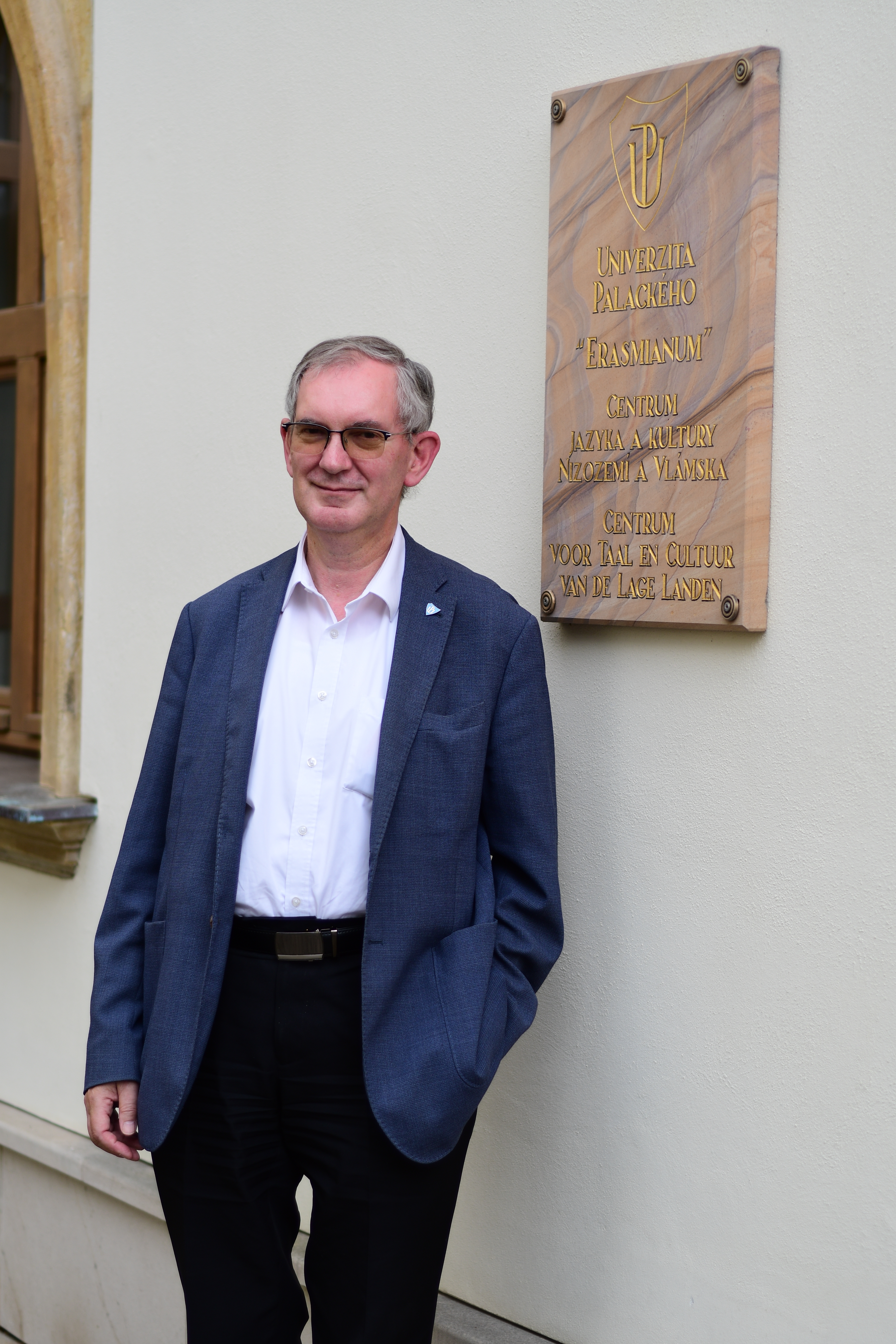
Wilken Willem Karel Hugo Engelbrecht was born on 19 September 1962 in Utrecht, the Netherlands. After completing secondary school, he chose to study Classical Philology at Utrecht University, where in 1986 he obtained a teaching qualification for secondary education. He then continued at the University of Amsterdam, graduating in 1988 in Greek and Latin language and culture. In the late 1980s he developed his profile as a medievalist with a strong interest in the manuscript tradition. As part of his own research plans he traveled extensively across Europe to study medieval manuscripts in libraries; during that period he also visited Olomouc, still before the fall of the Iron Curtain. In 1990 he expanded his qualifications with a certificate to teach Dutch as a foreign language. In the autumn of that same year, a scholarship stay brought him to what was then Czechoslovakia, where he began working at universities and gradually took on teaching in Dutch as well as Latin. Between 1991 and 1994 he was involved in the restoration and development of Dutch lectorates in Bratislava and Olomouc. On 30 November 1992 he obtained permanent residence in Czechoslovakia, and in 1993 he married. His family life anchored him definitively in the Czech Republic, where he raised two sons, born in 1997 and 2006. Since October 1995 he has been long associated with Palacký University Olomouc—initially as a university lecturer in Dutch and later as a key figure in local Dutch Studies. Since 1 September 2003 he has headed this academic unit; in addition, from 2006 to 2010 he served as Vice-Dean for International Relations at the Faculty of Arts of Palacký University. He completed his doctoral studies on 18 June 2003 at Utrecht University in the field of Medieval Studies; on 21 May 2005 he obtained his habilitation at Palacký University in Literary Theory. In 1995 he co-founded the Central European association of Dutch scholars, Comenius, and has long supported regional cooperation within the field. In 2012 he was appointed an Officer in the Order of Orange-Nassau for his lifelong contributions—an honor he received from the Dutch ambassador. Professor Engelbrecht has institutionally anchored Czech (and broader Central European) Dutch Studies, educated many generations of graduates, and succeeded in linking academic study with the practical fields of translation and interpreting. At the same time, he openly emphasizes that this is a small and vulnerable discipline that can survive only thanks to cooperation across the faculty and because it gives students skills that are also usable beyond the university.