"And the conditions in detention are terrible, I didn't expect that. Every now and then you watch a film where the plot is situated with prison, and you get a picture and an understanding. But when you get there yourself, you realize that the real world is like that. Back then, at the beginning of the protests, and still today, fifty people were sitting in four-bed cells in Okrestina being tortured. And now it goes on in a way that people don't have food or medical packages. People are sitting there with nothing, regardless of their health condition, whether they are men or women... And it's even harder for the women because they're menstruating and there are no hygienic pads or anything. They sit in total isolation for ten to fifteen days, even one day... I think every minute there is torture."
"And my friend comes to them and tries to say something normal, that we have to resolve this situation. And one of the officers pushes her away, she falls, hits her head on the pavement. She doesn't break her head, but she gets dizzy. And that's when some people we call "tichari" come up to her, they could just be people in dark clothing. At the moment my friend is lying down, I start shouting at the policemen, 'How can you do this?' And they look at me. That's when someone punches me in the jaw - a big punch. I fall either from the blow or from surprise. I fall down, my jaw hurts, I check - it's not broken and it's good. My friends are gone, everyone's going about their business, it's chaos. I get up, I am getting up. And the second blow under my ribs. The blows were so hard, I immediately fell. I'm lying down, my jaw hurts, my rib hurts. I can barely get up, I want to help my friend. I get up a third time and a man hits me right in the chest with a boot or something. And that's it."
"And he [the investigator] was going from office to office, and I was sitting in a chair. He was walking around, milling around, and he tripped over my foot and knocked my feet. I sat up straight. Then he came in a second time - he sat on my hands and he says, 'Do you like me?' And I said, 'No, no, no, no, no, no, no, no.' And you sit in the office with all the investigators and you realize that anything can happen to you at any moment, just anything. I'm thinking of a softer way to put it, and I'm saying, 'It's not that I don´t like you, it's that I have my own values.' And so I'm thinking, 'No, no, no, no, no, no, no, no.' He's saying, 'It's going to be okay. I'll make a deal, we'll go to the Minsk Sea and drink champagne.' I'm thinking, 'Let me at least drink water, why champagne?' And I'm sitting there and I don't understand what's going on at all: on the one hand, a criminal case, and here - an unexpected situation."
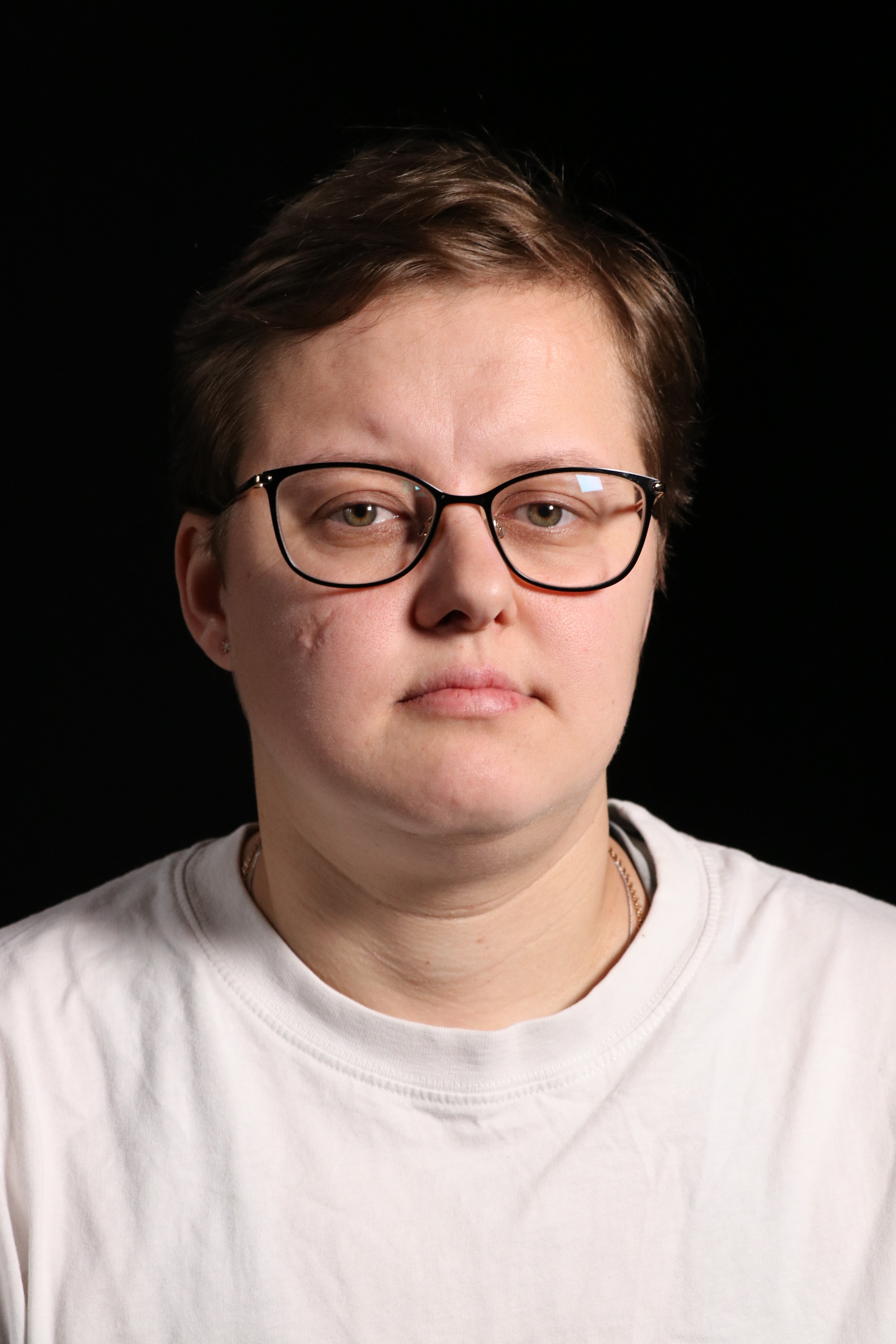
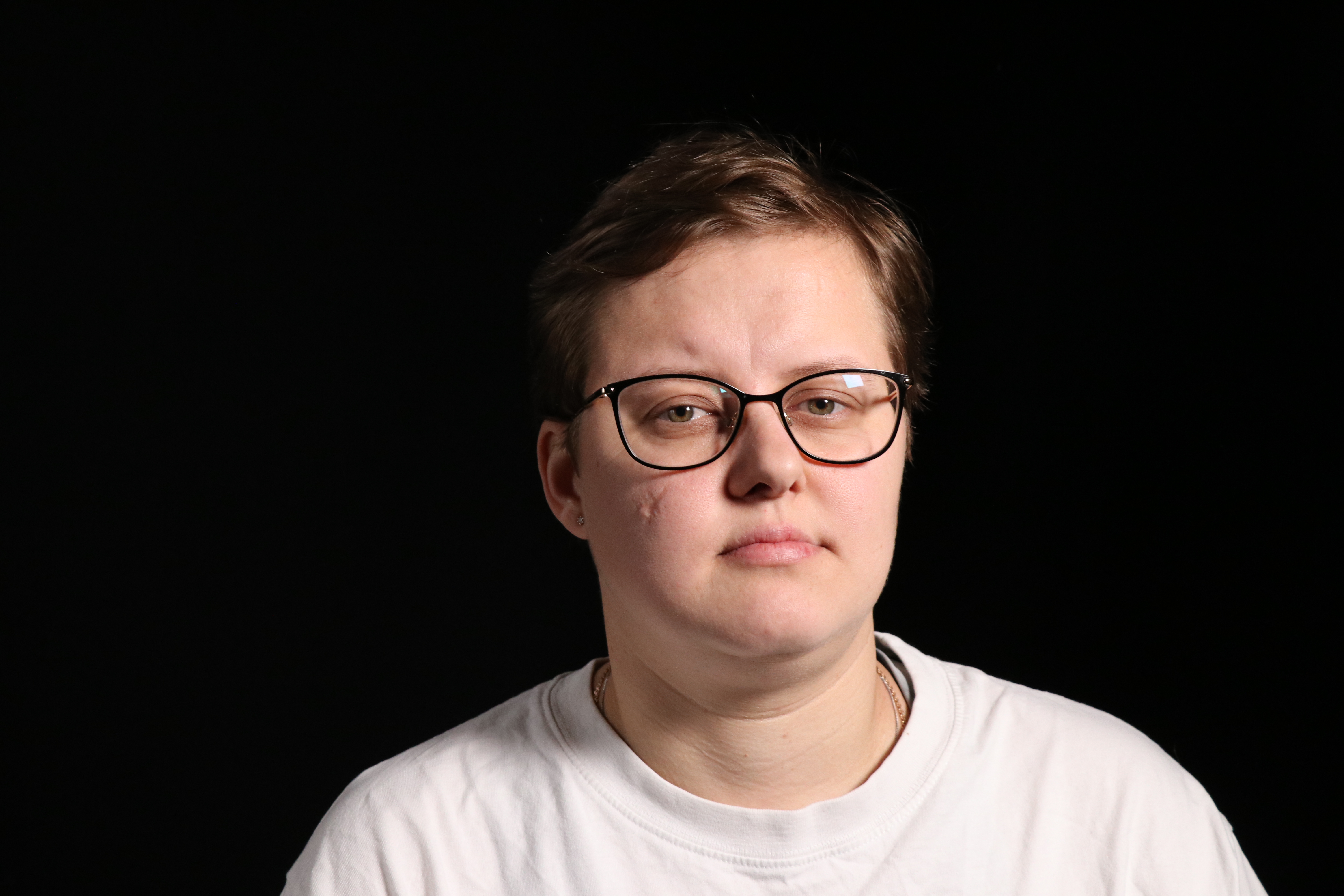
Maria Bobovich (Belarusian: Maryia Bobovich), born on 26 May 1995 in the town of Mozyr in the Gomel region of southern Belarus, is a Belarusian civil activist, political prisoner (2020), participant in protests against the Lukashenko regime, volunteer in humanitarian missions in Ukraine (2022). She graduated from the Mozyr Polytechnic School, majoring in insurance (2014), then graduated from the Belarusian State University of Economics (part-time, majoring in finance and banking, 2018). She worked in an insurance company, later as an assistant cook in a restaurant in Minsk. In 2020, she participated in protests against electoral fraud in Minsk. On 9 September 2020, she was arrested for writing „We will not forget“ on the asphalt at the site of the death of unarmed protester Alexander Taraikovsky. She spent three months in pre-trial detention (Okrestina, Zhodzina, Volodarka). In December 2020, she was sentenced to a year and a half of limited freedom (a punishment that is usually referred to as „domestic chemistry“). In 2021, she fled to Ukraine via Russia after threatening to substitute house arrest for a colony prison sentence. Since February 2022, she has been helping in humanitarian missions: clearing debris in Bucha, evacuating residents of Kherson Oblast. Since 2023, she has been living in Poland, where she coordinates assistance to Belarusian political emigrants. She has been granted the status of political prisoner by Belarusian human rights organisations.