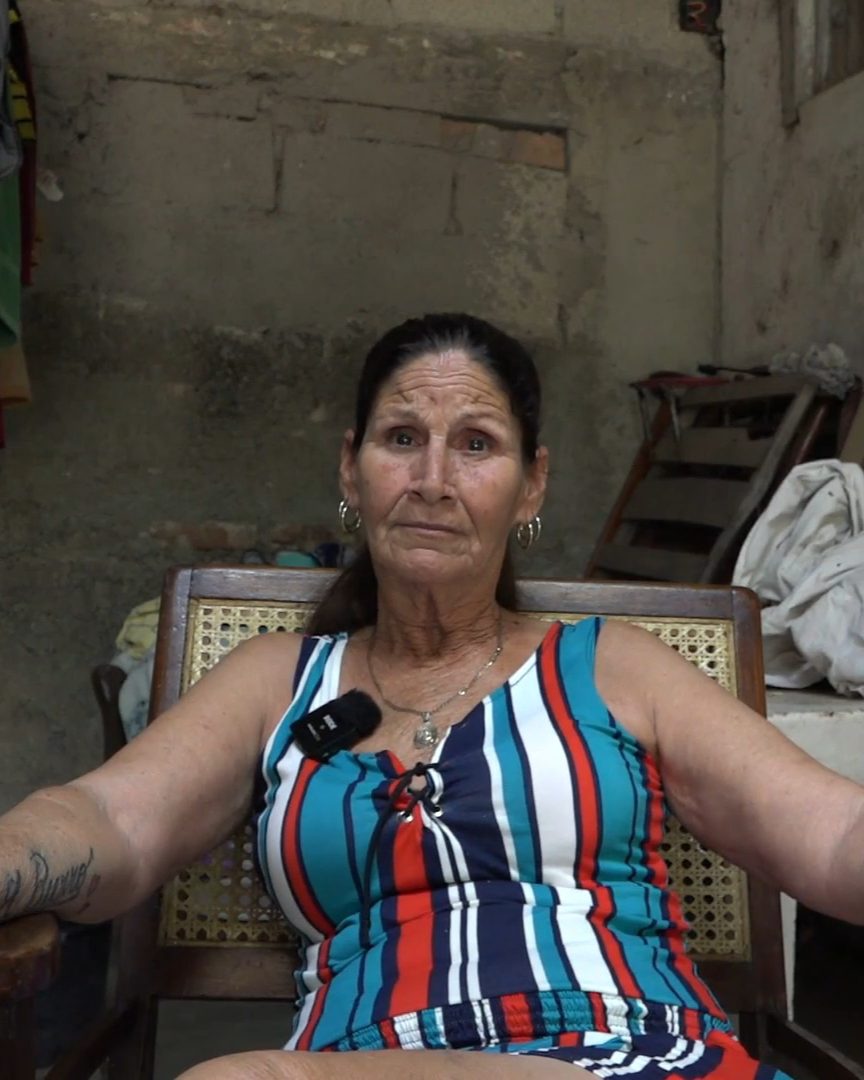
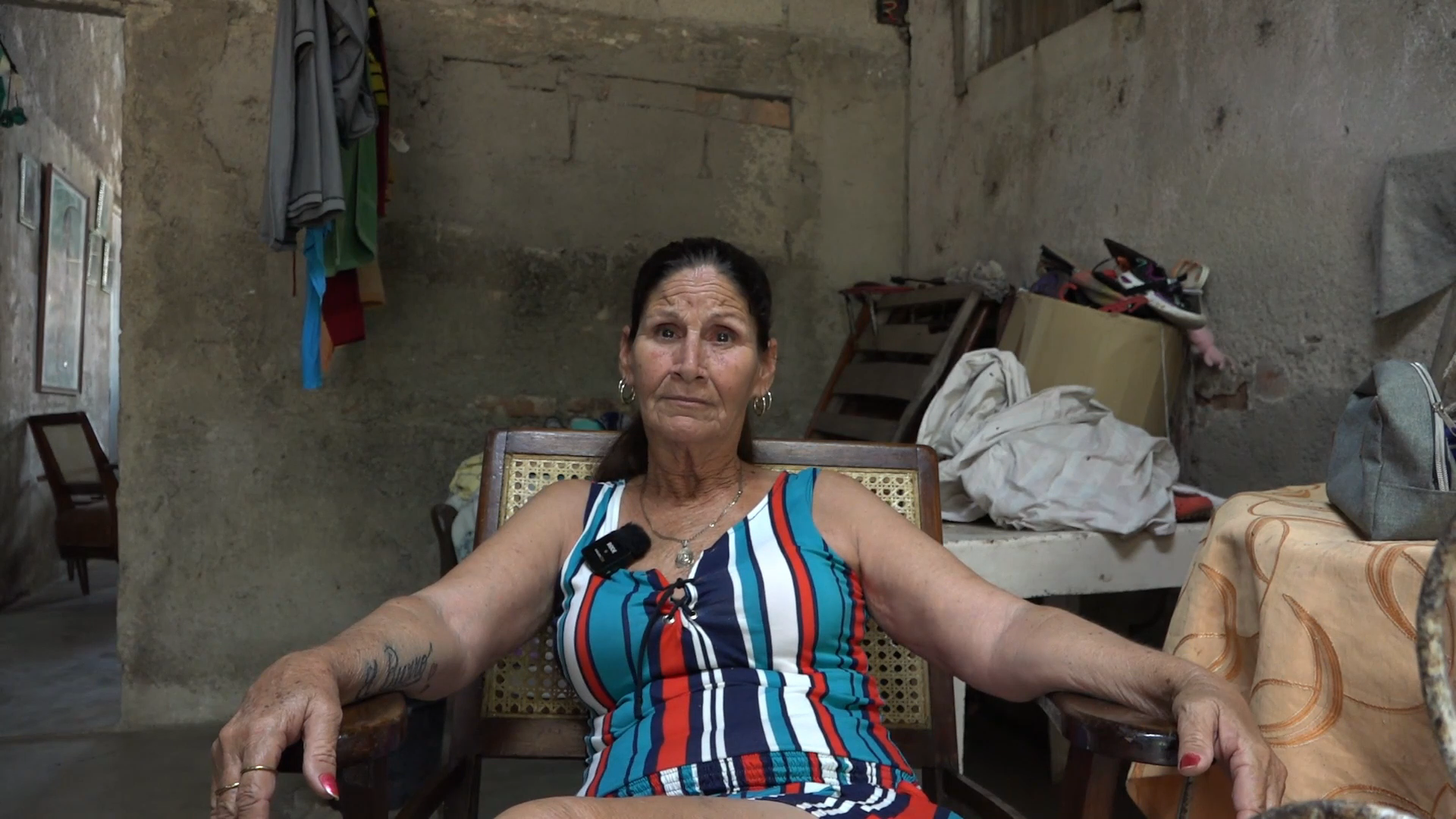
"There are no achievements, because nothing was ever achieved. Cuba, its whole life, was like a crab. Instead of moving forward, it always moved backward. Look, Cuba has made no progress at all. We are going to become Indians again. Don't be alarmed. The time will come when we will no longer have these little lights that you see. We're going to live in this country like Indians in ancient times, when there was no electricity, which was brought in later with the revolution. The best thing Cuba had, the sugar mills, was taken away. When they destroyed the sugar mills, there was nothing left."
"My son climbed to the top of the ETECSA tower. The wind was blowing him up and down. At one point, we thought he was going to fall. The wind was very strong up there. He looked like a little doll this size. This tower is really tall. All he shouted to the police was not to take a step because if they did, he would jump. He was tired and humiliated, and it was all their fault. They should send a helicopter and let him leave the country. He had already been caught four times trying to leave illegally. The first time he was in prison for a year, the second time for a year and a half, and the third time for three years. They should let him live; they hadn't let him live since he was 15. If one of them tried to climb the tower, he would jump. He was going to make his statement from up there. When the people saw him, they supported him greatly, calling him the leader of the country, homeland, and life, saying that it was impossible to live with the blackouts, that we were living oppressed and humiliated. He asked for a plane, a helicopter." // "There was a boy who supported my son, according to the people and the crowd that was there. He shouted 'homeland and life' and participated in the demonstration. They summoned him too. They summoned him, my son, and his nephew. They say there were a few more, but I didn't see them. A few days before (his son's death), I saw this boy on the corner and he told me that he had been summoned again and that he was tired of these singaos. And a few days later, my son was dead, at the hands of this citizen. I can't tell you how it happened in real life, because I wasn't here, I was in Cienfuegos. They tell me he was standing outside with a gay couple and they say he came to knock on this door here to ask my son for a cigarette. My son told him he didn't have any cigarettes, but he could give him a cigar. But this story is badly told. The gay couple ran away from the neighborhood. One left the country and only returned when the trial took place. He lives in Oriente and never appeared at the trial. I found the flip-flops of the boy who killed my son inside our house. They did the tests and they were positive that they were his. What was he doing inside the house? The two gay men who were the only witnesses did not appear at the trial. It will be two years since my son died, the trial took place, and I still haven't received the verdict."
"It's the same government (that's to blame). Ever since the government allowed prostitutes in Cuba. Cuban women used to be the most modest women in the world. The most valuable women. Now we're not even worth twenty kilos on the market. Didn't you know? Ever since prostitution was allowed in this country, it all started. It spread completely. Fifteen-year-old boys kill each other with machetes in nightclubs, in the middle of a park, in a meadow... Don't call the police, they won't come."
"Ever since I can remember, my dad was always in jail. He and my mom made empanadas and sold them on the street to support us. That's how we got the TV and refrigerator in our house. My dad was born into a revolutionary family. But he was the black sheep. Once, he killed my grandfather's calf. My grandfather reported it to the police, and my father had to serve his sentence. My grandfather knew that my father had seven children in the family, but he didn't care; he made him serve his time. That's how things were back then. Later, when my father was released, he was marked for life. They didn't give him any breathing room. If a sign was moved in Cruces, they sent the PNR to look for him. They followed him everywhere he went. My dad wasn't against the system, apart from participating in the Limpia del Escambray, but then he suffered a huge disappointment. // In the 1980s, with the Mariel, they knocked on our door. In this municipality, they made a conga that went street by street playing music, throwing eggs, stones, sticks. And we were waiting for them to come to us. First the police came and knocked on our door. They told my dad and my brothers that they had to leave the next day or we would all go to jail for four years. We decided that my dad had to leave the country, because at his age he wouldn't have been able to endure prison, and my brothers went with him. The girls stayed with my mom. The other day we joined the demonstration and shouted slogans against our family so they would leave us alone. My father and my brothers left in 1980. The family was destroyed. I haven't seen my brothers in over forty years. And my dad died there. They were thrown out of their country. The people of 1980 were thrown out of their own country. Dishonorably.
Estrella Alfonso de Armas was born in the province of Cienfuegos into a family whose destiny has been strongly marked by the events that took place in Cuba after the triumph of the Cuban Revolution. If any stage of his life can be described as truly happy, it would be his childhood. Her father came from a family that supported the revolution and even participated in the Limpia de Escambray, during which combat units were sent to fight counterrevolutionary rebels in this region in the early 1960s. However, Estrella‘s father was always the black sheep of the family and quickly lost his drinking habit. From then on, he became the object of interest for the authorities. Together with Estrella‘s mother, he had to make an enormous effort to support the family of seven children. The two of them made empanadas at night at home, and the father sold them during the day on the streets to ensure that the children had everything they needed to be happy. In the early 1980s, the family was threatened with imprisonment if they did not leave the country. In the end, her father, who was already quite old, and Estrella‘s brothers left for the United States, and she has never seen them again. The persecution of the family reached its peak with Estrella‘s children‘s generation. One of them, Liván, climbed an ETECSA (Cuban Telecommunications Company) tower in the city of Cruces in 2022 to protest against the Cuban regime after a long power outage. He not only wanted to draw the population‘s attention to the frequent and massive power cuts, but also wanted to express his frustration after having had to struggle for many years with harassment by the authorities and multiple imprisonments. His attitude led countless local residents who were watching his attempt to climb the tower to express their disagreement with the government‘s policies, and Liván was summoned to the police. Soon after, following several arrests, Estrella was found dead in his home. Two years have passed since then, and the circumstances have still not been clarified. When it comes to Cuba‘s future, Estrella expresses a very pessimistic view and argues that the Castro legacy will be felt in the country for a long time to come, as the descendants of the ruling family will remain in power. He believes that one day, Cubans will abandon their homes without electricity and move to the mountains, where they will live like the indigenous population did before the arrival of the Spanish colonizers.