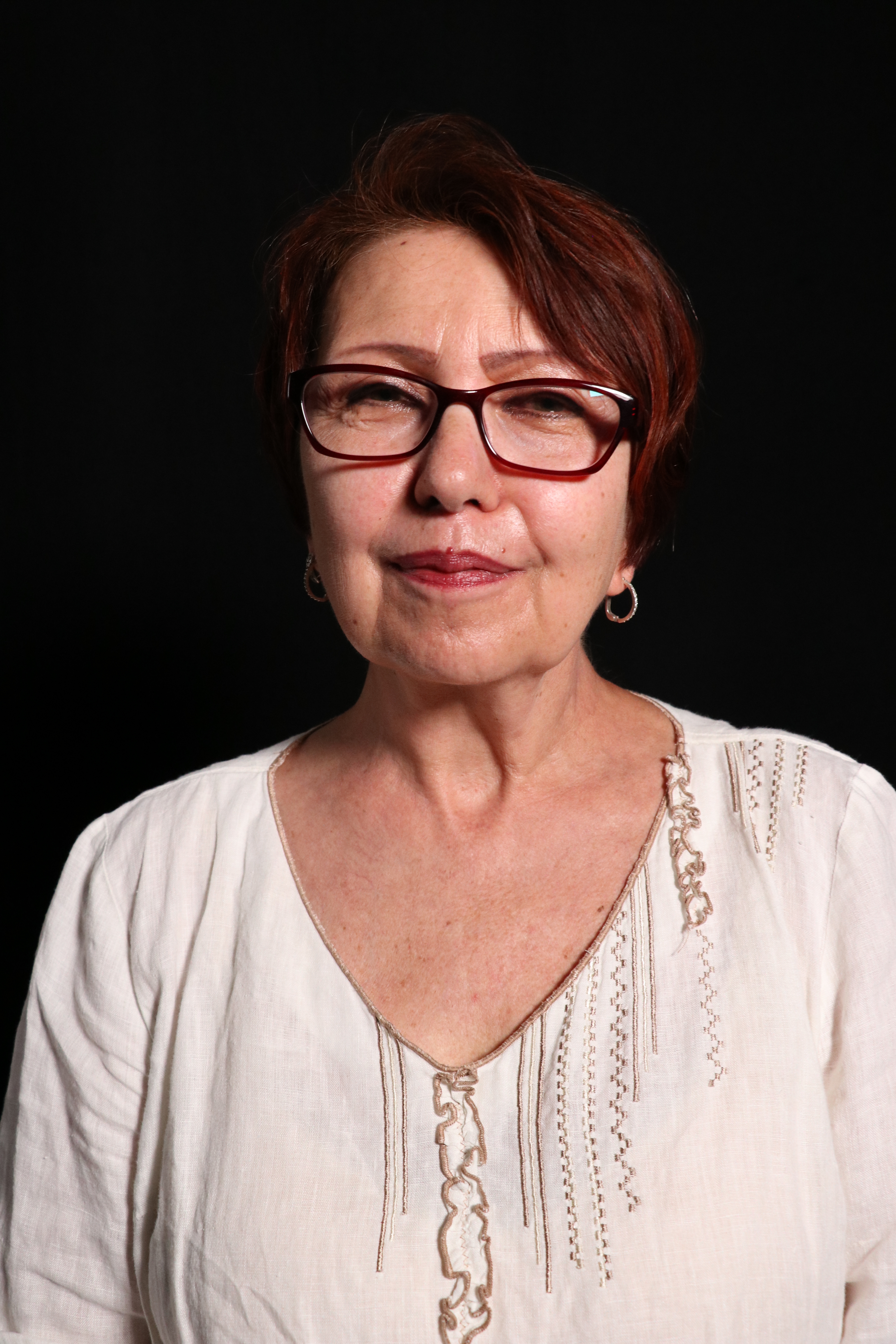
"I want to say that what is happening in Ukraine now is not just a war of Ukraine against Russia. In reality, it is a war of good and evil. This is a story that is not just about Ukrainians. It concerns the whole world and Europe in particular. Perhaps the most fitting phrase for this is one that is more than a century old and was also associated with the Prague Spring of 1968, proclaimed by the dissidents in Red Square and recalled throughout the Maidan: 'For our freedom and yours'. Because the freedom of Ukraine is the freedom of Europe and of the world. That is why, in thanking you for your support, I would like to emphasise the understanding of shared responsibility and - even though this may not be a very positive ending - the fragility of peaceful existence, of truth. When you are here, you feel it much stronger than when you are in Kiev. At least I do."
"As I was recording an interview with the director of the museum as part of our project 'Historians on the Revolution of Dignity', the director Vladyslav Chubanyuk is a professional historian with a teaching degree. When he told me about his Maidan experience, he said: 'When I heard about it, I also went to Kiev on the 18th. When I got to Uman, my colleagues stopped me and said, 'Don't go to Kiev, we have our own affairs here, we need you here more.' He spoke about his feelings. It was in Uman, those small towns... later on, he went on some errands and went through a few more, and he saw the same situation everywhere: people armed themselves with whatever they could - hunting rifles, shovel handles, rakes, whatever. He said: 'I looked at it, I'm a historian, and I see that Makhnovshchina is starting. Because if, God forbid, something goes wrong, riots will break out, they'll all rise up! I saw with my own eyes the Ukrainian insurgency movement starting in places!' This is one more element of the Ukrainian mentality and consciousness."
"In the village, all the activities started at the museum. Literally the entire village gathered there the next day to decide what to do. This, by the way, is also an element of Ukrainian organisation. They gathered to decide precisely who was guarding what, when, and where. They split into brigades, some were guarding at night and some not; the checkpoints would be set up... See, nobody knew what was going to happen. The breakthrough from the south, the Dnieper, Voznesensk, that's the straight direction on that side to Vinnytsia, to Uman. Again, damned paratroopers! Nobody knew what would happen. People mostly thought 'we're in World War II'. The village was guarded at night, with all the windows blacked out. 'You've got something flashing in the street, cover it up so it doesn't...' Women used to meet in the museum. It was winter, there wasn't much farm work to do yet. Someone had a cow, but there weren't many; we discussed it. They tended to the chickens and came to the museum - and they were weaving nets. We knitted nets and made preserves and sent them to the soldiers. A volunteer movement started; somebody knew exactly where to take it. They came, packed the cans, the kids painted something. The whole process of self-organisation - who is knitting, who is cutting, who is bringing lunch: 'Here I baked you girls some pierogi...', you just feel part of the community. You understand the village society exists, it works together."
"The Maidan is basically a bad place to defend; it is located in a valley and is very easy to attack and from any direction - left, right, top. That's why Maidan is more of a sacred place. Why all the Ukrainian revolutions take place there has no logical explanation, except that it is perceived as a kind of a sacred place. Since when it is sacred, that would require a special research; I don't have any answer now [2024]. Maybe since 1990, I don't know. Why? It was a place of military parades in Soviet times, it wasn't sacred back then. Maidan didn't exist at all until the 19th century; it was Kozyno boloto [Goat Swamp - the historical name of the location where Independence Square is today]. The place rose during the construction boom in Kiev. An archaeological survey was carried out during the refurbishment of the square after 2000, and many interesting objects were found. There is the gate through which Batu [the Mongol khan] entered Kiev. None of these things confirm its sanctity, but for some reason it happens to be such."
"There were two moments during the march that I remember, certainly because they were both very significant for me. The first one was when the parade was moving along Khreshchatyk. There were some Ukrainian-speaking boys and girls on the left and on the right. I'm not sure but I had the feeling they likely came from western Ukraine, maybe not. A little ways down the road was a somewhat older man of clearly Jewish nationality. There were always quite a lot of Jews in Kiev. We lived in Podolia; I went to school there and certainly a half of my class were Jews. My best friend who moved to the United States later on was Jewish. This guy was distinctly Jewish and had this look in his eyes... He seemed to want to take a step into the parade but couldn't make up his mind. The boys walking next to me made this gesture - come with us! Come on, join in! He took that step and joined the march. The second moment was as we reached the High Council. The people had dispersed a bit around the Mariinsky Park and I noticed a couple of older people, probably married. Not Kievans, likely Lviv or western Ukraine judging by their look. They were holding a poster together that said 'We don't want to live the Lenin way, we want to live like humans'. The image of those two people... Today, I would definitely walk up to them and ask them who they were and where they were from. I have this feeling that maybe they had lived during the time of the UPA [Ukrainian Insurgent Army] and took part [in the uprising]. I can't prove it, but I think so for some reason today. They somehow reminded me of those people with their age, look and posture. There was this dignity and confidence and peace in their posture. That impressed me."
Viktoria Kolesnikova is an archaeologist. She has worked at the Institute of Archaeology of the National Academy of Sciences of Ukraine all her life. She defended her dissertation thesis in science history focused on archaeologist of Czech origin, Vikentiy Vyacheslavovich Khvoyka (Čeněk Chvojka). As a science historian, she has long focused on the Maidan phenomenon in Kiev. She was born in Kiev, Ukraine on 27 September 1959. Her father was a ship designer. The family was Russian-speaking. Young Viktoria‘s life was shaped by her father‘s sister Tamara, an archaeologist who took Viktoria on expeditions from the age of 15. Thanks to her, Viktoria Kolesnikova also became an archaeologist and began to speak Ukrainian. Aged less than 17, she joined the Institute of Archaeology, and completed university at night while working. Since 1990 she has actively participated in all the revolutions on the Maidan in Kiev. She co-founded a museum and library dedicated to the Maidan and has co-authored and worked on the project „Historians on the Revolution of Dignity“, recording and editing witnesses‘ recollections. In the spring of 2014, she joined the civic initiative „Reanimation Package of Reforms“. She voted for Petro Poroshenko in both the 2014 and 2019 presidential elections. Since 2020, she has been actively working in the Society of Archaeologists of Ukraine and served as an expert of the Ukrainian Cultural Fund for three years. After the outbreak of the Russian-Ukrainian war on 24 February 2022, she lived in the countryside of the Cherkasy region for five months, knitting protective nets with local women and preparing humanitarian aid for the army. She also filmed and edited interviews with witnesses. On returning to Minsk, she and her colleagues resumed work, but it has been severely affected and limited by the war. Unable to live in exile, she has occasionally gone abroad (Germany, Lithuania, Czech Republic) since 2023. At the end of 2024 she was still working at the Institute of Archaeology.